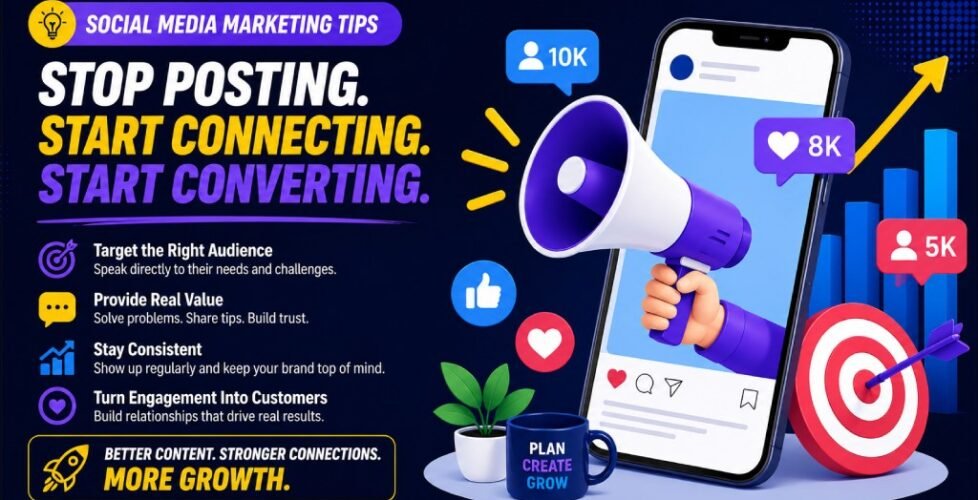
Social Media Marketing Tips to Reach More Customers
One of the most important social media marketing tips for businesses is surprisingly simple: stop trying to reach everyone.
However, it can be tempting to create content designed to appeal to as many people as possible. After all, more potential viewers should mean more customers, right?
Not necessarily.
The problem with trying to appeal to everyone is that your content can become so broad that it doesn’t really speak to anyone. Your posts may look professional, but they don’t necessarily give your ideal customer a reason to stop scrolling, read your message, or take action.
Instead, effective social media marketing isn’t about reaching everyone. However, the focus is on reaching the right people with the right message at the right time.
Why Targeted Content Works Better
Think about the last time you were scrolling through Facebook, Instagram, LinkedIn, or TikTok.
Additionally, you probably passed dozens of posts without giving them much attention.

Then you saw something that immediately caught your attention because it addressed a problem you were experiencing.
Moreover, targeted content demonstrates its power.
For example, imagine a web design company posting:
Additionally, we provide high-quality digital services for businesses of all sizes.
There’s nothing technically wrong with that statement. But it’s generic.
Now compare it with:
“Small business owner? If your website looks outdated and isn’t bringing you customers, here’s what you should fix first.”
However, the second message is much more specific.
In addition, it identifies a particular audience, addresses a specific problem, and creates curiosity about the solution.
That’s what you want your social media content to do.
Identify Your Ideal Customer
Before creating your next social media post, ask yourself:
Who am I trying to reach?
Don’t simply answer “everyone who might need my service.”
Get more specific.
Consider:
- What type of customer are you trying to attract?
- What industry are they in?
- What problems are they experiencing?
- What questions do they frequently ask?
- What are they trying to accomplish?
- What keeps them from reaching their goals?
- What would make them stop scrolling?
The more clearly you understand your audience, the easier it becomes to create content that resonates with them.
For example, a restaurant shouldn’t necessarily create content for “people who like food.”
A better audience might be:
“Local families looking for an affordable place to have dinner on Friday night.”
That gives you a much clearer direction for your content.
Use the WHO + PROBLEM + PROMISE Formula
One simple way to create stronger social media posts is to use this formula:
WHO + PROBLEM + PROMISE
Start by identifying the person you’re speaking to.
Then identify a problem they have.
Finally, provide a reason to continue reading by promising useful information, a solution, or an outcome.
For example:
“Small business owners: If you’re spending hours every week trying to create social media posts, here’s how to create a week’s worth of content in less time.”
Let’s break that down.
WHO: Small business owners
PROBLEM: Spending too much time creating content
PROMISE: Learn how to create a week’s worth of content more efficiently
That is much more compelling than simply saying:
“We can help with your social media marketing.”
The first version provides value. The second sounds like an advertisement.
Solve Problems Instead of Constantly Selling
Another important social media marketing tip is to avoid turning every post into a sales pitch.
People don’t generally follow businesses because they want to see advertisements all day.
They follow businesses because they want something useful, entertaining, educational, inspirational, or interesting.
Your content should answer questions and solve problems.
For example, instead of posting:
“Contact us today for social media management.”
Try:
“Posting consistently but getting almost no engagement? Here are three reasons your content may not be connecting with your audience.”
Now you’re giving people something useful.
At the end of the post, you can still include a call to action.
But the CTA becomes secondary to the value you’re providing.
Make Your First Few Seconds Count
Social media users scroll quickly.
Consequently, your opening sentence, headline, image, or video should give people a reason to stop.
Weak:
“Here are some social media tips for your business.”
Stronger:
“However, your business doesn’t have a social media problem. You have a consistency problem.”
Or:
“If your social media posts are getting views but no customers, here’s what you’re probably missing.”
These statements create curiosity.
The goal isn’t to trick someone into clicking. It’s to make a legitimate promise that the rest of your content delivers on.
Create Content for Different Stages of the Customer Journey
Not everyone who sees your social media content is ready to buy.
Some people are discovering your business for the first time. Others are researching their options. Some already know you and are almost ready to become customers.
Your content should address all three groups.
Awareness Content
Help people discover you.
Examples include:
- Industry tips
- Educational videos
- Common mistakes
- Quick facts
- Helpful statistics
- Short tutorials
Consideration Content
Help people understand why your solution may be right for them.
Examples include:
- Case studies
- Before-and-after examples
- Comparisons
- Frequently asked questions
- Customer success stories
- Behind-the-scenes content
Conversion Content
Give people a reason to take action.
Examples include:
- Special offers
- Consultations
- Free guides
- Product demonstrations
- Service explanations
- Limited-time promotions
A healthy social media strategy uses a combination of all three.
Consistency Still Matters
Targeted content is important, but consistency matters too.
Creating one excellent post and then disappearing for three weeks makes it difficult to build momentum.
You don’t necessarily need to post five times a day.
What matters more is developing a schedule you can realistically maintain.
For example, you might publish:
- Two educational posts each week
- One short-form video
- One customer-focused post
- One promotional post
The exact schedule will depend on your business and audience.
The important thing is to establish a repeatable system.
Measure What Actually Matters
Don’t judge your social media strategy solely by follower count.
A post with 10,000 views isn’t necessarily successful if none of those viewers become customers.
Pay attention to metrics such as:
- Engagement
- Comments
- Shares
- Saves
- Website traffic
- Leads
- Direct messages
- Conversions
The ultimate goal of social media marketing isn’t simply to collect likes.
It’s to build awareness, relationships, trust, and ultimately business.
Start Talking to the Right People
If your social media content isn’t getting the results you want, don’t automatically assume you need to post more.
Start by asking a better question:
“Am I talking to the right people?”
Define your ideal customer.
Identify their problems.
Create content that addresses those problems.
Give them useful information.
Make your opening compelling.
Stay consistent.
And give people a clear next step when they’re ready to learn more.
The goal isn’t to make everyone stop scrolling.
The goal is to make the right person stop scrolling.
That’s when social media marketing becomes much more powerful.
When your content makes your ideal customer think, “They’re talking directly to me,” you’ve taken the first step toward turning a social media viewer into a potential customer.