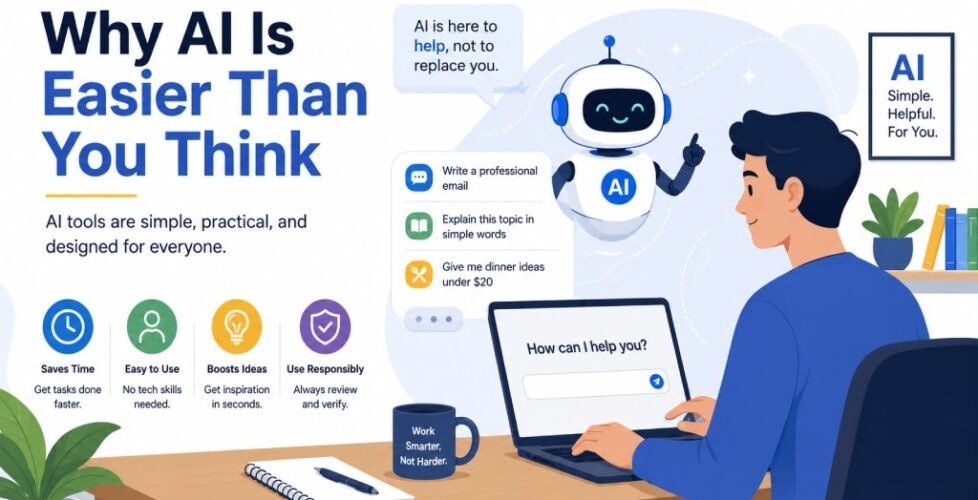
AI Is Easier Than You Think — Here’s Why
Mention artificial intelligence (AI) in a room full of people, and you will likely get two very different reactions. Some eyes light up with excitement. Others glaze over entirely. If you are in the second group, you are not alone. For many people, AI sounds like something reserved for engineers, scientists, or tech companies with unlimited budgets. However, that picture is quickly changing — and the reality of AI today may surprise you.
AI Is Built for Everyday Users
Years ago, using advanced technology often required special training. However, modern AI platforms are built to feel familiar and easy to use.
 For example, chat-based AI tools work much like texting another person. You ask a question, and the system responds with an answer. In many cases, using AI feels more natural than using traditional software menus.
A small business owner might use AI to write social media captions. Meanwhile, a student may use it to summarize notes. Parents can even use AI to plan grocery lists or meal ideas. These are simple tasks, yet they save time and reduce stress.
Because of this, AI is becoming less intimidating for beginners.
You Do Not Need Coding Skills
One of the biggest myths about AI is that you must know programming. While developers build AI systems, most users never touch code at all.
Instead, modern AI tools focus on conversation and instructions. For instance, you can type:
- “Write a professional email”
- “Explain this topic in simple words”
- “Give me dinner ideas under $20”
The AI then responds based on your request.
This is important because it lowers the barrier for beginners. Rather than learning technical commands, users simply explain what they want.
As a result, more people feel comfortable experimenting with AI technology.
AI Already Fits Into Daily Life
Some people think AI belongs only in tech companies. However, AI already appears in everyday tools many people use without noticing.
Here are a few common examples:
- Streaming services recommending movies
- GPS apps finding faster routes
- Spam filters blocking junk email
- Online stores suggesting products
- Voice assistants answering questions
These features rely on AI systems working quietly in the background.
Therefore, learning to use AI does not always mean learning something completely new. In many cases, it simply means understanding technology that is already around you.
AI Saves Time on Repetitive Tasks
Many beginners become interested in AI because it helps save time. Although AI is not perfect, it can reduce repetitive work.
For example, a freelancer might use AI to organize ideas before writing an article. Likewise, a teacher may use it to create lesson outlines. Small business owners often use AI to draft marketing content or answer customer questions faster.
Instead of replacing human thinking, AI usually works best as a support tool.
That distinction matters. AI can help generate ideas quickly, but humans still make decisions, edit mistakes, and add personal judgment.
Consequently, AI works best when paired with human oversight.
Common Concerns About AI
Despite its benefits, some people remain cautious about AI. These concerns are understandable.
One common argument is that AI can produce incorrect information. This is true. AI systems sometimes make mistakes or present inaccurate details confidently. Because of this, users should always double-check important facts.
Another concern is job replacement. While AI may change certain industries, many experts believe it will also create new opportunities. Historically, technology has often changed jobs rather than eliminating work entirely.
For example, calculators changed accounting work but did not eliminate accountants. Similarly, AI may automate repetitive tasks while allowing people to focus on creative or strategic work.
Privacy is another concern. Some AI tools collect data to improve performance. Therefore, users should read privacy policies and avoid sharing sensitive personal information.
These concerns are valid, yet they do not mean AI should be avoided completely. Instead, they highlight the importance of responsible use.
Beginners Often Overthink AI
Many people avoid AI because they believe they are “not tech-savvy.” However, using AI is often easier than learning traditional software.
Think about smartphones. Years ago, people worried smartphones would be difficult to use. Today, most people navigate apps, messaging, and online banking without much trouble.
AI is moving in a similar direction. Developers know that simple design matters. As a result, many AI platforms now focus heavily on user-friendly experiences.
In fact, beginners often learn faster by trying simple tasks instead of studying technical explanations.
For example, asking AI to help rewrite a message or organize ideas can be a good starting point. Small experiments help users gain confidence naturally.
AI Works Best With Clear Instructions
Although AI is simple to start using, better instructions usually lead to better results.
For instance, asking “help me write a blog post” may produce a general response. However, asking “write a beginner-friendly blog post about healthy eating with short paragraphs” gives the AI more direction.
This process is sometimes called prompting.
Fortunately, prompting does not require advanced skills. Instead, it mainly involves being specific and clear.
Here are a few easy ways beginners can improve AI responses:
- Use simple language
- Explain the goal clearly
- Mention tone or style
- Ask follow-up questions
- Request revisions when needed
Over time, users naturally become better at communicating with AI tools.
AI Is a Tool, Not Magic
Some online discussions exaggerate what AI can do. However, realistic expectations are important.
AI cannot replace human emotions, real-world experience, or critical thinking. It also cannot guarantee accuracy every time. While AI can help generate ideas quickly, it still requires human judgment.
At the same time, AI can be extremely useful for organization, productivity, brainstorming, and communication.
The key is understanding AI as a tool rather than a perfect solution.
A calculator helps with math, but people still need to understand numbers. Similarly, AI helps process information faster, but humans remain responsible for final decisions.
The Future of AI Will Likely Become More Accessible
As AI tools continue improving, they will probably become even easier to use.
Many companies are already simplifying interfaces and adding AI features into existing apps. Consequently, people may use AI daily without even thinking about it.
This trend could help small businesses, students, and everyday users work more efficiently. However, responsible use will remain important as AI becomes more common.
Learning the basics now can help people feel more comfortable with future technology changes.
Conclusion
AI is often presented as something highly technical or difficult to understand. However, most modern AI tools are designed for ordinary people, not computer scientists.
You do not need coding skills to benefit from AI. In fact, many beginners already use AI every day through apps, search engines, and online services.
Although AI has limitations and risks, it can still be a helpful tool when used responsibly. More importantly, starting with AI does not require expert knowledge. Simple tasks, clear instructions, and realistic expectations are usually enough.
For beginners, the biggest challenge is often not the technology itself. Instead, it is the assumption that AI must be difficult.
Once people try it for themselves, many realize AI is much easier to use than they expected.
If you’re ready to try AI, check out ChatGTP, Gemini or Claude.
Frequently Asked Questions
Do you need technical skills to use AI tools?
No, most AI tools are designed for regular users. In many cases, you simply type a question or request in plain English. Although developers build AI systems, everyday users can benefit from AI without learning programming or advanced computer skills.