How Graphic Designers Can Pivot With AI and Stay Profitable
Artificial intelligence is changing the creative industry faster than most people expected. For many graphic designers, that creates uncertainty. Clients are experimenting with AI tools, businesses are producing content faster, and social media is filled with predictions that “AI will replace designers.”
But that’s not what’s actually happening.
The designers who are struggling are usually the ones competing only on production speed. The designers who are thriving are learning how to combine creativity, branding, strategy, and AI into a new kind of service.
AI is not eliminating the need for designers. It’s changing what clients value.
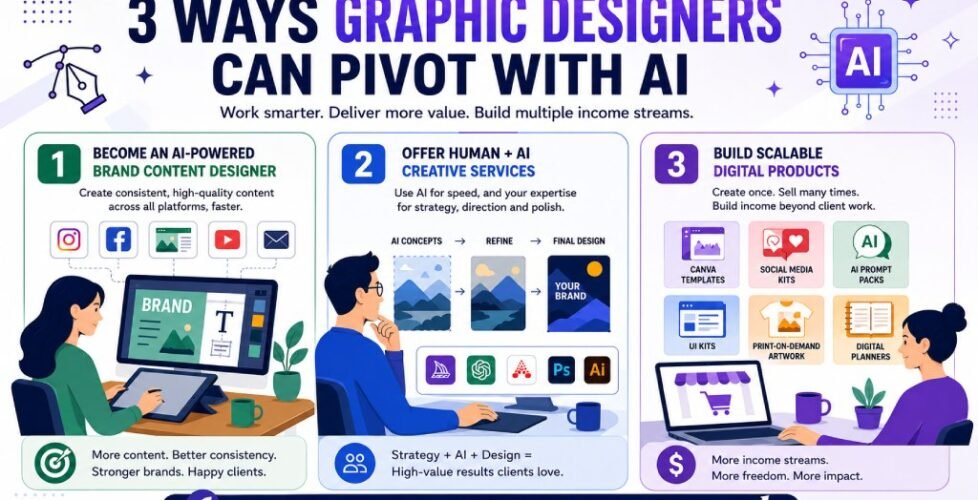
Here are three ways graphic designers can pivot with AI and remain highly profitable in the years ahead.
1. Become an AI-Powered Brand Content Designer
Traditional graphic design work often focused on single deliverables:
- A logo
- A flyer
- A website banner
- A social media graphic
Today, businesses need much more than that. Brands now require a constant flow of content across multiple platforms:
- Instagram posts
- Facebook ads
- LinkedIn graphics
- YouTube thumbnails
- Email headers
- Blog images
- Short-form video visuals
The demand for content has exploded.
This is where AI becomes an advantage instead of a threat.
Designers can now use AI tools to rapidly generate concepts, layouts, mockups, and visual variations. Instead of spending hours creating first drafts, AI can accelerate the brainstorming and production process dramatically.
But businesses still need someone who understands:
- Branding consistency
- Color psychology
- Typography
- Audience targeting
- Visual storytelling
- Marketing strategy
 AI can generate images. It cannot replace creative judgment.
A skilled designer who understands branding and marketing can now produce 5x more content while maintaining quality and consistency. That means faster turnaround times, better client retention, and the ability to take on more projects without burning out.
The opportunity is no longer just “designing graphics.” The opportunity is becoming a full-service visual content partner for brands.
2. Offer Human + AI Creative Services
Most businesses are curious about AI, but many have no idea how to use it effectively.
They may experiment with tools like Midjourney, ChatGPT, Gemini, Adobe Firefly, or Canva AI, but they quickly realize something important:
AI outputs still require direction.
This creates a huge opportunity for graphic designers.
Instead of competing against AI, designers can position themselves as the person who knows how to direct AI professionally and turn rough outputs into polished commercial-ready designs.
This new role combines:
- Creative direction
- Prompt engineering
- Brand strategy
- Visual refinement
- Human editing
For example, a designer might:
- Use AI to generate initial concepts
- Refine the strongest ideas
- Rebuild or polish them in Adobe Illustrator or Photoshop
- Deliver a professional final product optimized for the client’s audience
This workflow dramatically increases efficiency.
Projects that once took days can sometimes be completed in hours. That doesn’t mean charging less. In many cases, it means increasing profit margins because less time is spent on repetitive production work.
Businesses are not paying only for software access. They are paying for:
- Taste
- Strategy
- Experience
- Decision-making
- Branding expertise
The real value is no longer just technical execution. The real value is knowing what works visually and commercially.
Designers who learn AI early can become highly valuable because they bridge the gap between technology and creativity.
3. Build Scalable Digital Product Income
One of the biggest opportunities AI creates for designers is scalability.
In the past, many designers relied entirely on client work. That often meant trading time for money with inconsistent income.
AI now allows designers to create digital products much faster and at greater scale.
Examples include:
- Canva template packs
- Social media kits
- Presentation templates
- AI prompt packs
- Website UI kits
- Print-on-demand artwork
- Digital planners
- Stock illustrations
- Etsy downloads
Instead of creating one-off work for one client, designers can build products once and sell them repeatedly.
This changes the business model completely.
A designer can use AI to:
- Generate concept variations
- Speed up ideation
- Create asset collections
- Produce marketing materials faster
- Test multiple styles quickly
The result is the ability to launch digital products and create additional revenue streams without increasing client hours.
This is especially important because the creator economy continues to grow rapidly. Small businesses, coaches, influencers, startups, and content creators constantly need visual assets.
The demand for high-quality design is not disappearing. It’s expanding.
The difference is that designers now have tools that allow them to operate more like creative studios instead of solo freelancers.
The Designers Who Will Win in the AI Era
The future does not belong to designers who resist AI completely.
It also does not belong to people who rely entirely on AI-generated outputs without understanding design fundamentals.
The designers who will thrive are the ones who combine:
- Creativity
- Branding knowledge
- Marketing psychology
- Communication skills
- AI-assisted workflows
AI is automating repetitive production tasks. That’s true.
But clients still need people who can:
- Understand audiences
- Build recognizable brands
- Communicate emotion visually
- Create trust through design
- Turn ideas into compelling visual experiences
Those are human skills.
Graphic design is not dying. It’s evolving.
And the designers who adapt early may ultimately become more profitable, more scalable, and more valuable than ever before.