Why XRP Will Never Reach $10,000
The idea that XRP could reach $10,000 per token gets thrown around a lot in crypto circles and seems to be peak on Twitter. It’s exciting, it’s viral, and it sells hopium—but it doesn’t hold up under even basic economic scrutiny. If you zoom out and look at market structure, global finance, and adoption realities, the math simply doesn’t work. I’ll explain.
Let’s break this down logically, without hype.
The Market Cap Problem
The biggest issue with a $10,000 XRP is simple: market capitalization.
Get Personalized Crypto Coaching
XRP has a total supply of 100 billion tokens. Even if we assume the lower circulating supply of 50 billion tokens, the valuation required for a $10,000 XRP would push its total market cap into the trillions of dollars.
That’s not just unrealistic—it’s beyond the scale of the entire global financial system.
For perspective:
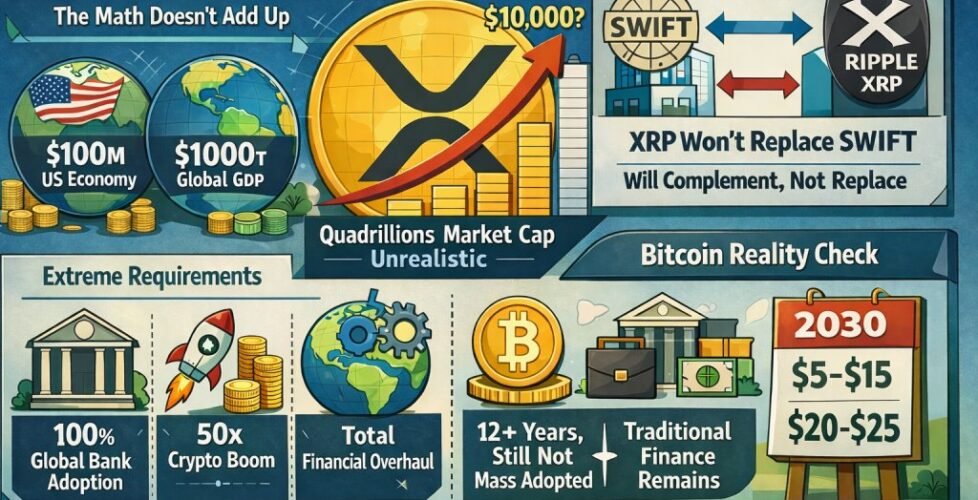
- The total U.S. GDP is roughly $25–30 trillion
- The entire global GDP is around $100 trillion
- A $10,000 XRP puts its market cap at $500 trillion
A $1,000 XRP alone would already imply a valuation that rivals or exceeds the size of the U.S. economy. At $10,000, you’re talking about numbers that dwarf global wealth itself.
At that point, you’re no longer predicting price—you’re imagining a complete rewrite of how money works worldwide.
Even $1,000 Requires Extreme Conditions
Let’s be clear: even a $1,000 XRP isn’t just “unlikely”—it would require a perfect storm of extreme scenarios:
- 100% global bank adoption
- XRP becoming the dominant bridge asset for all international settlements
- A massive 50x expansion of the entire crypto market
- SWIFT using XRP 100%
- A complete overhaul of the global financial system
That’s not gradual adoption—that’s total transformation.
And history shows us that financial systems don’t change overnight. They evolve slowly, with resistance from institutions, governments, and legacy infrastructure.
XRP Will Not Replace SWIFT
A common narrative is that XRP will replace the global SWIFT network. That’s not how this plays out.
SWIFT is deeply embedded in the banking system. It connects over 11,000 financial institutions worldwide and processes trillions of dollars in transactions daily.
XRP, through Ripple, is designed to complement existing systems—not completely replace them.
Banks don’t rip out infrastructure overnight. Instead, they adopt tools that improve efficiency alongside what already works. XRP’s realistic role is as a liquidity bridge in certain corridors—not as a total replacement for SWIFT.
Adoption Reality Check: Look at Bitcoin
If you want a reality check, look at Bitcoin.
Bitcoin has been around since 2009. It’s the most recognized cryptocurrency in the world, with institutional backing, ETFs, and global awareness.
And yet—even after more than a decade:
- It’s not used for everyday payments at scale
- It hasn’t replaced traditional finance
- Mass global adoption is still limited
If Bitcoin hasn’t taken over the financial system after 15+ years, it’s unrealistic to assume XRP will suddenly achieve total global banking dominance in a short time frame.
The Misunderstanding of Utility vs Price
Another common mistake is assuming that utility automatically drives price to extreme levels.
Yes, XRP is built for fast, low-cost cross-border payments. But higher utility doesn’t mean infinite price appreciation.
Get Personalized Crypto Coaching
In fact, for a bridge asset, there’s an argument that:
- Faster transaction speeds reduce the need for high price per token
- Liquidity efficiency can reduce volatility, not amplify it
In other words, XRP’s utility may support growth—but it doesn’t justify astronomical price targets like $10,000.
A More Realistic XRP Outlook
Now let’s ground this in reality.
If XRP continues to grow, gains adoption in cross-border payments, and benefits from a broader crypto market expansion, a more reasonable long-term range looks like this:
- Base case by 2030: $5 to $15
- Bullish scenario: $20 to $25
Even these targets are not guaranteed—and they would likely take years of steady growth, regulatory clarity, and real-world usage to achieve.
This isn’t overnight success. It’s a long-term, gradual climb.
Time Matters More Than Hype
One of the biggest traps in crypto is compressing timelines.
People don’t just expect XRP to hit $1,000—they expect it to happen quickly. But financial infrastructure doesn’t move at internet speed.
We’re talking about:
- Regulatory frameworks
- Banking integrations
- Global liquidity corridors
- Institutional trust
These things take years—often decades—to fully develop.
The Bottom Line
A $10,000 XRP isn’t just unlikely—it’s economically impossible under current global conditions.
Even a $1,000 XRP would require:
- Global banking domination
- Massive crypto expansion
- A complete overhaul of the financial system
And none of those things are happening overnight.
A far more realistic expectation is steady growth into the $5–$25 range over many years, assuming everything goes right.
Get Personalized Crypto Coaching
That may not sound as exciting as $10,000—but it’s grounded in reality.
And in crypto, understanding reality is what separates long-term success from hype-driven disappointment.